B11. Change Management and Enablement
AI projects rarely fail because of technology and often fail because of people: a lack of leadership, low acceptance, unclear communication, or missing skills. Change management and enablement are therefore not a side issue but an integral part of the strategy, with their own roadmap and measurable outcomes.
What this chapter delivers: the concrete program for the mandate and budget from chapter B1. A change succeeds when seven questions are answered: who carries it, whom it affects, how people move through it, how they stay informed and involved, whether they can work with AI, whether it all works, and how it lasts. The sections follow this logic:
| Question | Section |
|---|---|
| Who carries the change? | Change roles |
| Whom does it affect, and where do they stand? | Acceptance |
| How do people move through the change? | Change curve |
| How do they stay informed and involved? | Communication |
| Can people work with AI? | Talent strategy and enablement |
| Is it all working? | Adoption metrics |
| How does the change last? | Reinforcement |
Change roles: who carries the change
Before the change is planned, it must be clear who actively carries it. These roles are not the technical and organizational roles from chapter B7 that build and operate AI; here it is about the people who drive the change forward in the company. Often it is the same person in an additional role. Three roles decide between success and standstill:
| Role | Task in the change | Typical staffing |
|---|---|---|
| Active sponsor | Carries the change visibly at the top: communicates personally and repeatedly, attends meetings, clears obstacles, and visibly uses AI themselves. A sponsor who only releases budget but stays invisible is the most common reason a change peters out. | The executive AI sponsor (see chapter B7), extended by the visible role |
| Change champions | Respected practitioners from the business units who voluntarily act as multipliers: they show the everyday benefit, answer questions among peers, and carry concerns back into the program. They convince where a directive from above does not reach. | Volunteers from the affected teams, not a full-time mandate |
| Leadership (middle management) | Translate the change for their team and lead by example. This layer carries every change or slows it: whoever sees their own manager hesitate hesitates too. They therefore need clarity and their own enablement early, before they pass it on. | Unit and team leads of the affected units |
Visible sponsorship is the strongest lever. Studies of change programs regularly name active, visible sponsorship as the most important success factor, ahead of communication and training. The difference is in the verb: not to support (passive, providing budget) but to lead by example (visible, repeated, in one’s own daily work).
Acceptance: understanding and addressing resistance
The greatest danger is a lack of trust. AI as a black box meets skepticism from employees (fear of job loss, loss of control), customers (data protection, fairness), and the public. Effective change management starts by taking these concerns seriously and demonstrating visible benefit, instead of mandating technology.
Template: stakeholder map
Why this tool: whether an AI rollout succeeds is decided by concrete people, because some can accelerate it and others block it. The stakeholder map (also called a stakeholder matrix or stakeholder analysis in the literature) makes these forces visible before they take effect: for each party, it captures the stance toward the initiative and the influence over it, and derives the appropriate measure. What is meant here are real people and groups within your own company, not abstract roles: for instance the works council, the head of customer service, or the middle management of an affected unit.
How to fill it in: every person or group with influence over the initiative gets a row. Stance and influence together determine the measure: influential skeptics are engaged early and turned into co-creators; influential supporters act as multipliers.
| Stakeholder | Stance (supportive / neutral / skeptical) | Influence (high / medium / low) | Main concern | Measure |
|---|---|---|---|---|
| Example: works council | Skeptical | High | Job cuts, performance monitoring | Early involvement, joint guardrails on non-surveillance |
| Example: head of customer service | Supportive | Medium | Quality of AI answers | Win as pilot area, make successes visible |
Change curve: guiding people through the change
The stakeholder map shows who stands where today. This section shows that no stance is fixed: people move through a change in phases, and each phase needs different support. Whoever mistakes a rejecting reaction for the end gives up too early, because it is often only a transitional stage. With AI in particular, the triggering concern is usually the fear for one’s own job.
| Phase | How to recognize it | What helps now |
|---|---|---|
| Uncertainty | Wait-and-see, many questions, rumors | Inform early and honestly about what changes and what does not (see the communication section) |
| Rejection | Open resistance, clinging to the old way | Take concerns seriously, involve those affected, show concrete relief instead of building pressure |
| Trying out | Cautious testing, first own experiences | Offer quick help, create visible successes, explicitly allow mistakes (see the talent strategy and enablement section) |
| Acceptance | AI becomes part of daily work, own ideas for improvement | Take up ideas, offer the champion role, reinforce the success (see the reinforcement section) |
Create the will (incentives). Knowledge and tools alone move no one; it takes a recognizable personal benefit. Three levers work: routine load falls away and more demanding work moves to the foreground, early users receive visible recognition, and there is the credible assurance that the time gained does not turn into job cuts. Incentives reward use, they do not punish reluctance: pressure produces token use, not acceptance.
Listen, don’t just broadcast (feedback). The communication plan in the next section pushes messages outward; it needs a return channel. Regular short surveys, open office hours, and a visible “this is what we changed based on your feedback” turn those affected into participants. Without a return channel, rumors fill the gap.
Communication
Communication implements what the stakeholder map and the change curve have revealed: the measures identified there need planned, regular communication instead of one-off announcements. A clear communication strategy conveys benefit and goals in an understandable way and is honest about change, because sugarcoated messages get exposed and cost exactly the trust that is supposed to be built.
Template: communication plan
The communication plan (also called a communication matrix) is the implementation tool for the stakeholder map: it translates the map’s findings into concrete, regular communication and defines who learns what, through which channel, how often, and from whom.
How to fill it in: for each audience, message, channel, frequency, and a responsible person are set. The pre-filled rows show typical constellations and are adapted to your own organization. An audience without a responsible person means in practice: this communication does not happen.
| Audience | Message | Channel | Frequency | Owner |
|---|---|---|---|---|
| Employees | What’s changing, what opportunities arise | Town hall, intranet | monthly | |
| Leadership | Progress, decisions, resources | Review | biweekly | |
| Affected business units | Concrete impact on daily work | Workshop | per rollout | |
| Customers / public | Benefit, fairness, data protection | Website, service | as needed |
Talent strategy and enablement
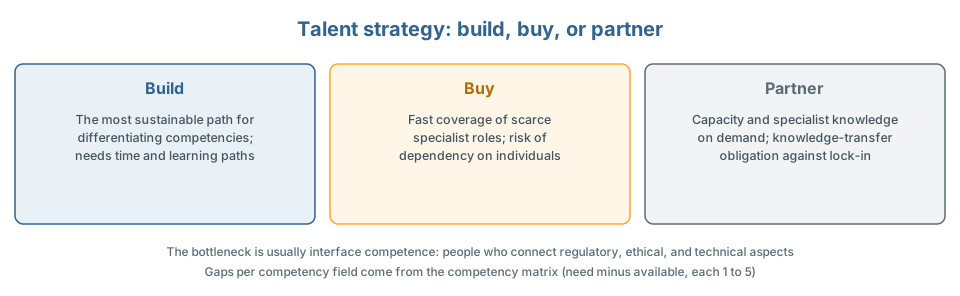
The talent strategy shifts perspective: the sections so far answer whether the organization accepts AI; the talent strategy answers whether it masters AI. The two belong together, because acceptance without competence leads to misuse, and competence without acceptance to unused tools. An operating model only works with the right capabilities. The bottleneck is usually not individual data scientists but interface competence: people who connect regulatory, ethical, and technical aspects. The talent strategy answers three questions: build, buy, or supplement through partners?
- Build: the most sustainable path for differentiating competencies; needs time and learning paths.
- Buy: fast coverage of scarce specialist roles; risk of dependency on individuals.
- Partner: capacity and specialist knowledge on demand; with a knowledge-transfer obligation to avoid lock-in (see chapter B3).
Template: competency matrix
The competency matrix turns the three paths into a concrete inventory: it contrasts the need with the existing skill level per competency field and thus shows where to build, buy, or supplement through partners.
How to fill it in: need and current level are rated per competency field from 1 (barely present) to 5 (strong). The gap is the difference. For every relevant gap, a strategy is set.
| Competency | Need (1 to 5) | Current (1 to 5) | Gap | Strategy (build / buy / partner) |
|---|---|---|---|---|
| Data engineering | ||||
| ML / data science | ||||
| MLOps / platform | ||||
| Generative AI / prompting | ||||
| AI law / compliance | ||||
| Product and process understanding | ||||
| Change and communication competency |
Learning paths and communities of practice
The competency matrix shows where competencies are missing; learning paths close these gaps in a structured way. A learning path defines per target group who learns what and at what depth, instead of prescribing the same training for everyone. Three levels interlock:
- Foundations for everyone: AI literacy in the sense of the EU AI Act: responsible use, limits, risks (mandatory, see chapter B8).
- Role-specific deepening: separate tracks for product owner, data owner, data scientist, operations, security.
- Communities of practice: fixed exchange rounds across unit boundaries, in which practitioners jointly maintain templates and best practices and newcomers receive mentoring. They keep what was learned alive once the training is over.
The learning offers are at the same time the most credible signal to the workforce that AI is meant as a tool that relieves and elevates employees rather than replacing them: routine tasks disappear, more demanding work moves to the foreground. Retraining and upskilling programs make this transition concrete and remove exactly the fear that appears in the stakeholder map as the most common main concern.
Adoption metrics
Whether the change is working, that is, stakeholders won over, messages received, and competencies built, remains a claim without measurement. The following adoption metrics make change success visible per use case; they are collected from the start and flow into ongoing reporting (see chapters D1 and D4):
- Usage rate: how many entitled users actually use the solution?
- Acceptance: satisfaction, voluntary recommendation.
- Training coverage: share of employees trained per role.
- Adoption rate: share of AI recommendations actually acted on.
- Time-to-competence: time until a role works productively with AI.
Reinforcement: making the change last
The adoption metrics show whether the change is taking hold. Reinforcement makes sure it stays once the program’s attention moves on. Without this step, teams revert to the familiar way without AI under everyday pressure, and measured usage drops again months after the start. Four mechanisms secure the change:
| Mechanism | What to do | Warning sign if missing |
|---|---|---|
| Anchor in goals and incentives | Where sensible, include AI use in performance goals and recognition, without turning it into surveillance (observe co-determination, see chapter B8) | Usage stays optional and falls asleep after the first wave |
| Celebrate successes visibly | Share early, concrete results (time gained, better quality) and name the champions and teams involved | The effort is visible, the benefit is not, and the narrative in the company turns negative |
| Deliberately close the old path | Where the AI solution is viable, dismantle the parallel legacy process in an orderly way instead of leaving it open | Under pressure the team falls back to the legacy process, and the switch never fully succeeds |
| Support after go-live | Do not end support at go-live, but carry the stabilization phase (hypercare, see chapter C3) | First problems remain unsolved, and trust breaks down early |
Checklist: change management and enablement
The checklist covers all sections of the chapter, from the change roles to reinforcement:
- Active sponsor named who visibly leads the change by example, not just releasing budget
- Champion network built in the business units; middle management enabled early
- Stakeholder map created, influential skeptics addressed
- Change curve considered: support planned for each phase
- Incentives for use set; two-way feedback channels established
- Communication plan in place per audience, with message, channel, frequency, and a named owner
- Competency matrix completed, gaps backed by a strategy
- Mandatory AI foundational training set up (EU AI Act literacy)
- Role-specific learning paths defined
- Communities of practice established
- Upskilling and retraining program planned
- Adoption metrics defined and anchored in reporting
- Reinforcement planned: anchor in goals, celebrate successes, close the old path, support after go-live