A1. Why an AI Strategy
What this chapter delivers: the case for why a company needs an AI strategy, in three steps: why the topic is urgent now, which costs accrue when no strategy exists, and what role this work plays in addressing them.
Why AI matters now
Artificial intelligence has arrived across the working world: a substantial share of knowledge workers already use generative tools in their daily work, often faster than their companies adopt them officially. The productivity effect is noticeable in practice, especially for routine tasks and for less experienced staff. For companies, adopting AI is therefore no longer an optional decision but an economic necessity. Those who do not steer its use leave it to chance, while competitors unlock efficiency and new value creation.
International competition sharpens the pressure: countries such as the US and China invest massively in AI ecosystems and produce innovation at high speed. At the same time, AI creates not just efficiency but entirely new business models, from predictive maintenance as a service to new forms of diagnosis in healthcare. Companies must therefore examine early how AI will change their industry, so they don’t become the target of disruption themselves.
Beyond technology and economics, societal acceptance decides success or failure. Questions of ethics, data protection, data sovereignty, and the labor market accompany every rollout. Transparent communication and visible benefit increase the willingness of employees and customers to engage. In Germany and the EU, funding programs (the National AI Strategy, Horizon Europe) and a binding legal framework (the EU AI Act) add to this. Both at once: an opportunity for funding and an obligation to comply.
The cost of having no strategy
A company without an AI strategy is not inactive as a result. Things happen anyway, just uncoordinated and unsteered. These costs accrue whether or not they are budgeted:
| Symptom | Cause | Consequence |
|---|---|---|
| Shadow AI | Employees use private AI tools (chatbots, browser extensions, AI add-ins) without approval, because no official path exists | Company data flows out uncontrolled, no traceability, compliance and reputational risk |
| Failed PoCs | Pilots are launched without scaling criteria and get stuck at the demonstration stage | Budget tied up without value creation, declining acceptance for further initiatives (see chapter C3) |
| Duplicated work in silos | Business units build parallel, uncoordinated solutions without a shared platform or standards | Redundant costs, incompatible point solutions, no reuse |
| Budget misallocation | Investment in technically impressive but low-value use cases due to lack of prioritization | Low return, loss of trust with management and oversight bodies |
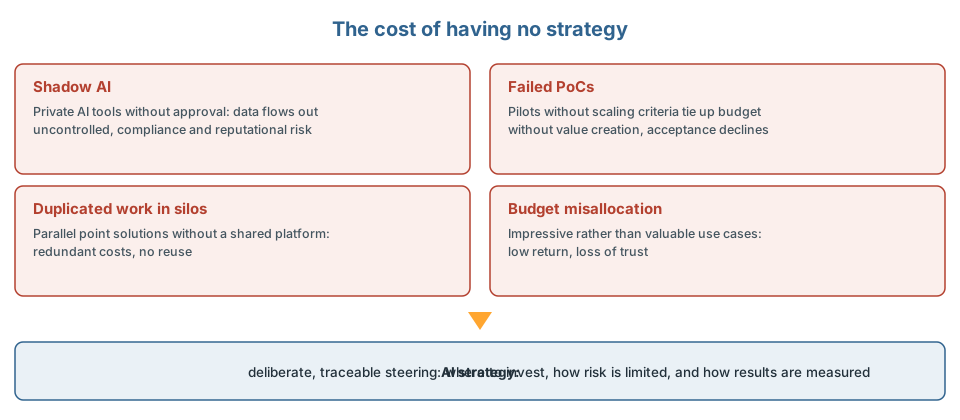
These losses are not a marginal phenomenon: the majority of AI pilots never reach production, and unapproved tools are already widespread in many organizations. What is notable is the reason: technology is rarely the main bottleneck, the lack of steering is, that is, unclear selection, a weak data base, low acceptance, and undefined responsibilities. This is exactly where the following parts come in.
An AI strategy replaces this randomness with deliberate, traceable steering: it sets where to invest, how risk is limited, and how results are measured.
Purpose of this work
This work is designed as a reference and working resource: the first point of contact for anyone who wants to understand and implement AI strategies. It combines concept and practice. Every chapter delivers not just explanation but methods, checklists, and templates that can be applied directly. The toolkit (Part E) bundles all artifacts in one place.
The work comprises 24 chapters in five parts (A to E). Every chapter carries a unique identifier such as A1 or B3 in its title and in the navigation, so it is always clear where you are. Chapter A4 contains the full overview and recommended entry points.
AI is not a finished project but a continuous process. Technology, data landscapes, and regulation keep changing, most recently through the Digital Omnibus to the EU AI Act (see chapter B8). A good AI strategy is therefore itself a learning one: it is regularly reviewed, adapted, and expanded. This work is designed the same way.